
Journal
DLF Golf Links: Buying and Selling Across The Aralias, The Magnolias and the Golf Course Road Corridor
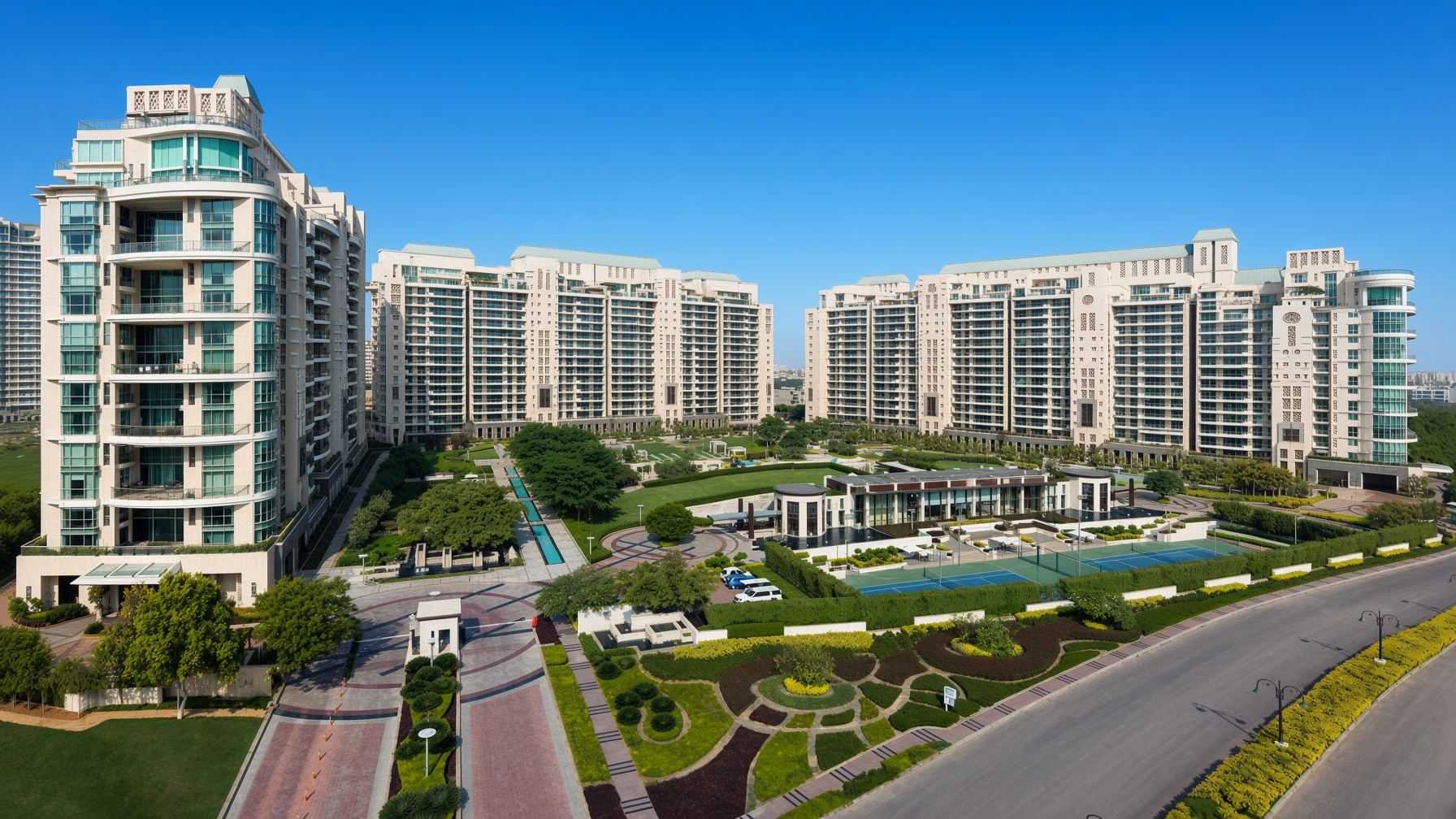
“DLF Golf Links” is used two ways in Gurugram real estate, and the difference matters if you're transacting there. Narrowly, it names DLF5 Golf Links — the roughly 200-acre Sector 42 estate, built around two Arnold Palmer and Gary Player-designed golf courses, that houses three residential enclaves: The Aralias, The Magnolias, and The Camellias. More loosely, buyers and sellers use it as shorthand for the whole Golf Course Road corridor — the address that, for two decades, has been Gurugram's default answer to “where does old and new money actually live.”
The Aralias is the corridor's original marquee address: 268 units across ten towers on roughly 22 acres, with close to 70% of the site kept as open space, apartments running around 5,800 square feet in 4 BHK and penthouse configurations. The Magnolias followed as the newer, larger-format sibling within the same estate. Both sit alongside The Camellias as the three reference points buyers mean when they say Golf Links.
Why the corridor runs almost entirely on private transactions
Golf Course Road has been established long enough that a large share of its owners are on their second or third decade of holding — many bought before the corridor was what it is today, and a sale now is as much a generational or portfolio decision as a market one. That kind of seller rarely wants a public listing attached to their name, and buyers at this level are usually working from a specific brief — a particular tower, a particular floor, a particular view of the golf course — rather than browsing what happens to be available. The two preferences reinforce each other: sellers who want discretion and buyers who want precision both get better outcomes from a direct, relationship-led search than from an open one.
What differs tower to tower
Diligence at Aralias, Magnolias, and Camellias is not identical, because the three enclaves are at different points in their lifecycle and were built under different agreement structures. An older Aralias resale is closer to a conventional secondary transaction — the regulatory safety net a first-time homebuyer relies on largely does not extend to it, so title, encumbrance, and the seller's authority to transact carry the full weight. A more recently handed-over Camellias unit is more likely to still involve a developer transfer or assignment process on top of those standard checks. Treating every Golf Links transaction as identical is one of the more common ways diligence falls short — the checklist has to match the specific tower and the specific agreement, not a generic template.
Sourcing and disposition on the corridor
On the acquisition side, most of what actually becomes available at Golf Links is surfaced through direct relationships with owners rather than any listing — by the time a unit here reaches a portal, it has often already been shown quietly to two or three qualified buyers. On the disposition side, the same logic runs in reverse: a seller's asset goes directly to a small, pre-qualified set of counterparties, with the fact of the sale contained to the people who need to know it.
Why this favours a single point of contact
Across three enclaves, multiple agreement structures, and an ownership base that values privacy as much as price, a mandate-based relationship — one brief, one point of contact, from origination to close — tends to outperform a broker relationship built to maximise how widely an opportunity is shown. For a Golf Links transaction specifically, that is less a preference than a practical necessity.
Independent commentary; not affiliated with or endorsed by DLF.